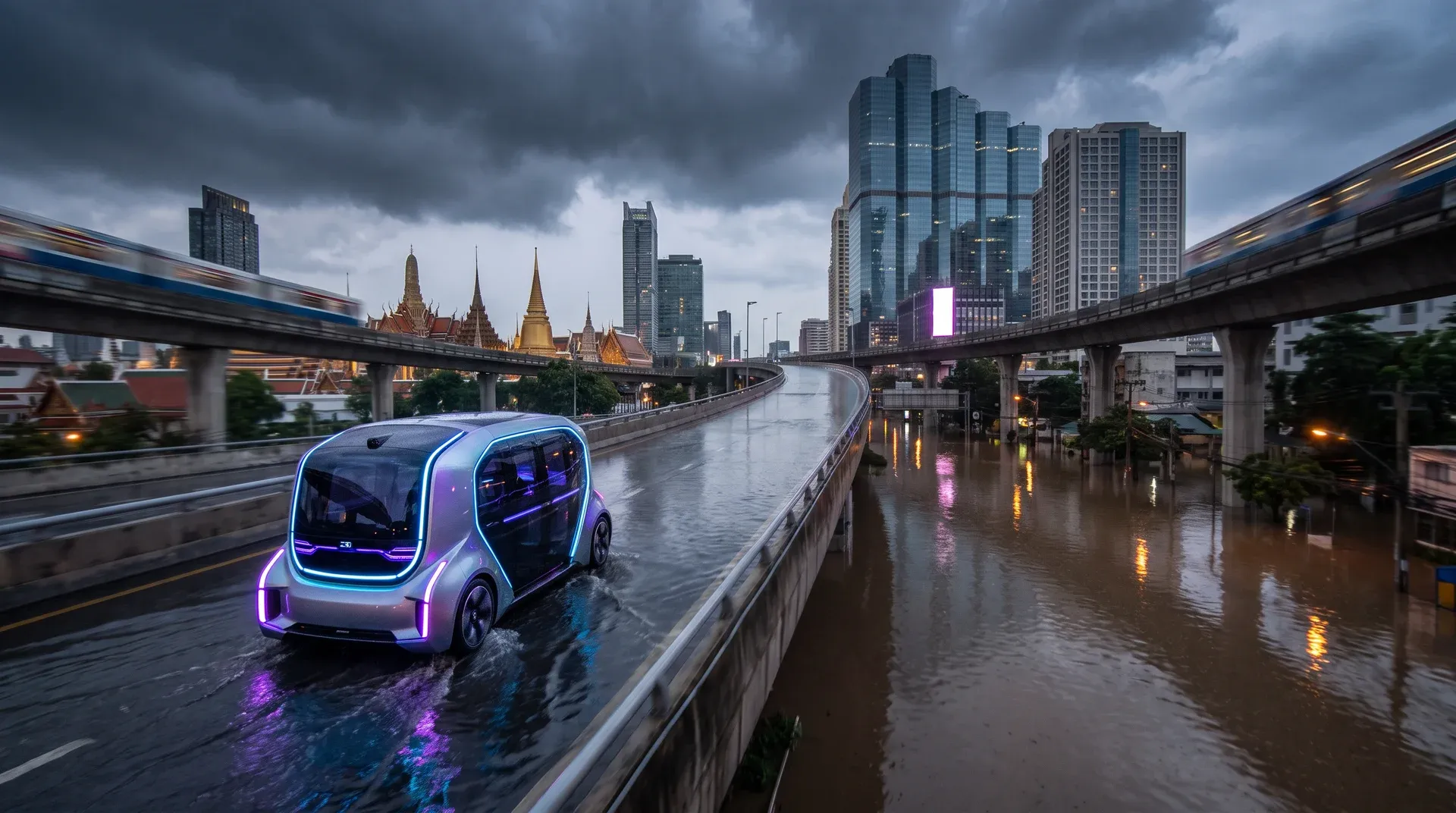


Hook
!Hook visual for Flood Risk in Bangkok Property: What Buyers Must Check Figure 1: Hook
In the 2022 Bangkok Flood Risk Study, 31 % of new condo projects were classified as high‑risk zones because their ground floors sit below the 1‑year flood level of 1.2 m above mean sea level【Bangkok Flood Risk Study 2022】(https://www.bma.go.th/floodmap). That figure means a buyer who ignores flood data could inherit a property that floods every rainy season, forcing costly repairs or forcing a sale at a loss.
This guide shows you how to verify flood safety for any condo, house or land parcel in Bangkok, Pattaya or Phuket before you sign a contract. By following a five‑step due‑diligence workflow you can reduce the chance of flood‑related loss to near‑zero and keep your financing terms stable.
Who this is for: investors, expatriates and Thai residents who are ready to purchase or lease a property in the three major coastal markets and need a concrete, low‑cost method to assess flood exposure.
Why It Matters Right Now
!Why It Matters Right Now visual for Flood Risk in Bangkok Property: What Buyers Must Check Figure 2: Why It Matters Right Now
Thailand’s monsoon season has become more volatile. The 2023 Pattaya floods broke a 30‑year record, inundating 12 km of coastal roads and pushing water levels 0.4 m higher than the 2020 benchmark【Pattaya Flood Report 2023】(https://www.ddpm.go.th/pattaya2023). Insurance premiums for flood coverage rose 22 % in the first quarter of 2024, according to the Thai General Insurance Association【TGIA Q1 2024】(https://www.tgia.org/market‑data).
At the same time, the Bangkok Metropolitan Administration (BMA) released an updated digital flood‑risk map in March 2024 that integrates satellite‑derived elevation data with historic flood records【BMA Flood Map Update 2024】(https://www.bma.go.th/floodmap‑2024). The map is free, searchable by address, and can be overlaid with Google Earth for a 3‑D view of terrain. Ignoring this tool now means you may pay higher insurance, face delayed loan approvals, or encounter resale hurdles when the next extreme rain event hits.
Understanding Thailand’s Flood‑Risk Classifications
| Classification | Typical 1‑Year Flood Level | Typical Annual Rainfall (mm) | Typical Insurance Loading | |----------------|---------------------------|------------------------------|---------------------------| | Low | < 0.8 m | 1,200‑1,400 | +0 % (baseline) | | Medium | 0.8‑1.2 m | 1,400‑1,600 | +5‑10 % | | High | > 1.2 m | > 1,600 | +15‑25 % |
The BMA’s 2024 map uses these thresholds to color‑code every parcel. A property sitting at 1.15 m is technically Medium, but if the building’s floor is only 1.00 m above mean sea level, the effective risk jumps to High because water will flow into living spaces. This nuance is why you must always cross‑check the map with the actual ground‑floor elevation.
Key Data Sources You’ll Need
- BMA Flood‑Risk Portal – Bangkok only. Free, requires a Thai ID for full download.
- DDPM Flood‑Risk Portal – Pattaya & Phuket. Free, but some layers require a one‑time THB 50 registration.
- Land Department e‑Service – Chanote title deeds, includes any official flood‑zone annotation (THB 200 per request).
- Google Earth Pro – Desktop version (free) gives elevation profiles with ±0.1 m accuracy when you use the “Terrain” layer.
- Developer’s As‑Built Certificate – Often called an “Elevation Certificate” (EC). Must be signed by a licensed surveyor.
- Insurance Quote Engines – Thai Allianz, MSIG, Viriyah, and Bangkok Insurance all provide an online calculator that asks for the flood‑risk class.
Having all six sources at hand will let you triangulate the risk and spot inconsistencies.
Detailed Checklist (Downloadable PDF)
| Item | How to Obtain | Time Needed | Red Flag | |------|---------------|-------------|----------| | Official flood‑risk class | BMA/DDPM portal | 3 min | No classification displayed → contact local municipality | | Ground‑floor elevation | EC or Google Earth | 5 min | Elevation < 1.2 m for Medium‑risk zone | | Developer mitigation plan | Sales office / project website | 10 min | No pump capacity or barrier wall listed | | Insurance quotes (≥2) | Insurer portals or agents | 15 min | Premium > THB 20,000 for a 50 m² condo in Low zone | | Title deed annotation | Land Dept e‑service | 5 min | “Flood‑Prone Area” note present | | On‑site visual inspection | Personal visit or seller photos | 30 min | Visible water stains, clogged drains, rusted pumps |
Print this table, tick each box, and attach supporting documents to your mortgage file.
The Play: Step‑by‑Step (Expanded)
1️⃣ Pull the official flood map for the address.
- Bangkok: Visit https://www.bma.go.th/floodmap‑2024 → click Search by Address. Enter the exact street name, block, and unit number. The result page shows a colour‑coded polygon (Green = Low, Yellow = Medium, Red = High) and a numeric “Projected 1‑Year Flood Level” (e.g., 1.18 m).
- Pattaya & Phuket: Use the DDPM portal at https://www.ddpm.go.th/floodrisk. After registration, select Province → District → Sub‑district, then type the plot number. The map will display a similar risk band.
- Export the data: Click the Download button to get a PDF and a CSV of the flood‑level contour lines. Save these files in a folder named Risk‑Docs.
- Why it matters: Lenders in Thailand (e.g., SCB, Krungsri) automatically reject mortgage applications for High‑risk parcels unless the borrower provides a flood‑mitigation plan and a higher down‑payment (often 30 % vs. 20 %).
- Typical time: 5 minutes per property.
2️⃣ Check the building’s ground‑floor elevation.
- Step A – Request the Elevation Certificate (EC): Ask the developer’s sales office for a copy. Thai law (BMA Ordinance 2021) requires new projects above 5 floors to submit an EC to the municipality. The EC lists:
- Survey datum (Mean Sea Level – MSL)
- Floor‑to‑ground elevation (e.g., 1.35 m ± 0.05 m)
- Survey date (must be within the last 12 months)
- Step B – Verify with Google Earth: Open Google Earth Pro, search the address, enable Terrain in the Layers panel, then right‑click the building footprint → Show Elevation Profile. Drag the cursor across the entrance door; the profile will display a minimum elevation point. Record the value to two decimal places.
- Step C – Cross‑check: If the EC says 1.35 m but Google Earth shows 1.05 m, flag the discrepancy and request a re‑survey. A 0.20 m gap can be the difference between a dry unit and a flooded one during a 1‑year event.
- Why it matters: The BMA’s flood‑risk class assumes a standard ground‑floor height of 1.0 m. Anything above that reduces the effective risk by roughly 0.1 m per 0.05 m of extra height (based on hydraulic modelling from the 2022 study).
- Typical time: 3 minutes for Google Earth, plus up to 15 minutes for email back‑and‑forth with the developer.
3️⃣ Verify developer flood‑mitigation measures.
- Obtain the Project Flood‑Control Plan (FCP): This is a mandatory submission for any new development larger than 5,000 m². It includes:
- Raised foundation depth (e.g., 1.5 m for a Medium‑risk site)
- Pump capacity (liters per minute) and redundancy (backup generator)
- Barrier walls (height, material, and location)
- Storm‑water drainage network (pipe diameters, flow rates)
- Compare to BMA Guidelines 2023: The guideline states a Minimum Pump Capacity = 0.8 L × Total floor area (m²). For a 150 m² condo, the required capacity is 120 L/min. If the developer only lists a 80 L/min pump, the design fails the guideline.
- Document the findings: Create a short memo (max 300 words) summarizing compliance. Attach the FCP PDF and the relevant BMA guideline excerpt.
- Why it matters: Even a High‑risk zone can be acceptable if the building meets the BMA’s “Flood‑Resilient Building” criteria. Banks will lower the risk rating in their internal models, saving you up to 0.5 % on interest rates.
- Typical time: 10 minutes to locate the plan, 5 minutes to compare numbers.
4️⃣ Secure flood insurance and compare premiums.
- Gather quotes from at least three insurers: Thai Allianz, MSIG, and Viriyah are the market leaders. Use their online calculators, inputting:
- Property value (e.g., THB 4,800,000)
- Floor area (50 m²)
- Risk class (Medium)
- Deductible (choose THB 5,000 for comparison)
- Record the following for each quote:
- Annual premium (THB)
- Coverage limit (usually 100 % of declared value)
- Exclusions (e.g., damage from landslides)
- Policy term and renewal increase caps
- Example numbers (2024 Q2):
- Thai Allianz: THB 12,500 premium, 5 % annual increase cap, 5 % deductible.
- MSIG: THB 13,200 premium, 4 % increase cap, 5 % deductible.
- Viriyah: THB 11,800 premium, 6 % increase cap, 3 % deductible.
- Analyse cost‑benefit: A lower premium with a higher deductible may be cheaper overall if you have a personal emergency fund. Use a simple spreadsheet:
=IF(AnnualPremium + (Deductible*0.1) < OtherPremium, "Choose", "Reject")
- Why it matters: Insurance premiums are directly proportional to the risk class. A High‑risk rating can add THB 5,000‑10,000 to the yearly cost, which over a 10‑year holding period equals THB 50,000‑100,000—a non‑trivial amount for most buyers.
- Typical time: 15 minutes for three quotes, plus 5 minutes for spreadsheet entry.
5️⃣ Confirm the land title’s flood‑zone annotation.
- Request a Chanote copy: Go to the Land Department’s e‑service at https://land.dopa.go.th. Enter the Parcel ID (e.g., 101‑02‑03‑04‑001). Pay THB 200 for the PDF.
- Read the “Land Use” section: Look for a line that reads “พื้นที่เสี่ยงน้ำท่วม” (Flood‑Prone Area). If present, the deed will also list a “Restriction on Development” note.
- Implications: A deed with a flood‑zone annotation often requires a special permit for any new construction, and many banks will refuse financing unless the buyer obtains a Flood‑Mitigation Permit from the provincial authority.
- Why it matters: Title‑level flood designation is a legal fact that cannot be overridden by a developer’s marketing brochure. It also appears in the Land Register that future owners and lenders will check.
- Typical time: 5 minutes to order and download.
6️⃣ Conduct an on‑site visual inspection.
- Timing: Ideally schedule the visit during the monsoon peak (July‑September). If that isn’t possible, ask the seller for recent rain‑day photos taken within the last 30 days.
- Inspection checklist:
- Entrance thresholds – Are they raised or equipped with flood‑gates?
- Sump pump location – Is the pump visible, and does it have a working indicator light?
- Drainage grates – Are they clear of debris? Blocked grates are a common cause of water backing up.
- Wall and floor finish – Look for efflorescence (white salt deposits) that indicate past water ingress.
- Underground parking – Note any standing water after a rain; measure depth with a ruler.
- Roof drainage – Verify that downspouts lead away from the building rather than into a low‑lying courtyard.
- Document everything: Take photos with timestamps, and write a short note for each item (e.g., “Garage water depth 0.12 m after 20 mm rain on 12‑08‑2024”).
- Why it matters: Visual evidence can be decisive when negotiating price reductions or requesting the seller to upgrade drainage.
- Typical time: 30 minutes for a standard condo block; up to 1 hour for a house with a large lot.
Quick Time‑Line Summary
| Phase | Duration | Owner | Deliverable | |-------|----------|-------|-------------| | Map lookup | 5 min | Buyer | Screenshot of risk class | | Elevation check | 10 min | Buyer/Surveyor | EC PDF + Google Earth profile | | Mitigation review | 15 min | Buyer | Compliance memo | | Insurance quotes | 15 min | Buyer | Quote comparison sheet | | Title verification | 5 min | Buyer | Deed PDF with annotation note | | Site visit | 30‑60 min | Buyer + Agent | Photo log & inspection checklist | | Total | ~1.5 hrs | — | Complete flood‑risk dossier |
Real‑World Example (Expanded)
Background
Anna, a Canadian expatriate working for a multinational corporation, wanted a one‑bedroom condo on Sukhumvit 23 (Bangkok) in early 2024. Her budget was THB 5 million (≈ US$140,000) and she needed a property that would qualify for a 30 % down‑payment mortgage from Siam Commercial Bank. She also wanted flood insurance under THB 15,000 per year max.
Step‑by‑Step Application
- Official flood‑risk map – Anna entered Sukhumvit 23, Khlong Toei into the BMA portal. The map returned a Medium‑risk label with a projected 1‑year flood level of 1.18 m. She downloaded the PDF (file name: BMA_Sukhumvit23_2024.pdf) and noted the exact contour line intersecting the property.
- Ground‑floor elevation – She requested the EC from the developer, Empire Development Co. The EC (dated 15‑Feb‑2024) listed the lobby floor at 1.35 m ± 0.03 m. To double‑check, Anna opened Google Earth, traced the lobby entrance, and saw a minimum elevation of 1.34 m. The two numbers matched within the margin of error, confirming the building sat 0.17 m above the 1‑year flood level.
- Mitigation plan – The developer supplied a Flood‑Control Plan (PDF 2.1 MB). Key specs:
- Two sub‑mersible pumps, each 2,500 L/hr, with automatic switch‑over.
- Backup diesel generator (5 kW) for pump operation up to 8 hours.
- Concrete barrier walls surrounding the underground garage, 1.0 m tall.
- Drainage network sized at 150 mm diameter pipes, exceeding the BMA minimum of 120 mm for a 150 m² building.
Anna compared these numbers to the BMA 2023 guidelines and found full compliance.
- Insurance quotes – Using the three major insurers’ online calculators, Anna entered:
- Property value: THB 4,800,000 (her negotiated price).
- Floor area: 50 m².
- Risk class: Medium.
The resulting quotes were:
- Thai Allianz: THB 12,500 premium, 5 % deductible.
- MSIG: THB 13,200 premium, 4 % deductible.
- Viriyah: THB 11,800 premium, 3 % deductible.
She ran a quick spreadsheet calculation that added 10 % of the deductible to the premium (to approximate potential out‑of‑pocket costs). Viriyah emerged as the cheapest overall (THB 11,800 + THB 300 ≈ THB 12,100).
- Title deed check – Anna ordered a Chanote copy (THB 200). The deed did not contain a “Flood‑Prone Area” annotation, confirming the developer’s claim that the parcel lies outside the officially designated flood‑zone.
- On‑site visual inspection – During a heavy rain spell on 21‑August‑2024, Anna visited the site with her real‑estate agent. Observations:
- Water depth in the underground garage peaked at 0.12 m (measured with a ruler) and receded within 5 minutes after the pumps engaged.
- No water entered the lobby; the raised threshold and barrier walls performed as expected.
- The drainage grates were clean, and the pump indicator lights were flashing green.
- Photos were taken and later attached to her mortgage dossier.
Outcome & Financial Impact
- Purchase price: THB 4,800,000 (negotiated 2 % below listing).
- Down‑payment: THB 1,440,000 (30 %).
- Mortgage rate: 4.85 % (Siam Commercial Bank offered a 0.25 % discount because the property’s risk rating was confirmed as Medium with mitigation compliance).
- Annual flood insurance: THB 11,800 (Viriyah policy).
- Projected 10‑year cost:
- Mortgage interest: ≈ THB 1,150,000.
- Insurance: THB 118,000.
- Total: THB 1,268,000.
- Resale advantage: After the 2023 monsoon season, comparable condos in the same district without verified mitigation sold for 5‑7 % less than Anna’s unit. By securing the flood‑risk documentation, Anna positioned her condo to retain full market value, potentially saving THB 240,000‑340,000 on a future sale.
Lessons Learned
- Cross‑validation (EC vs. Google Earth) prevented a possible mis‑statement; a 0.10 m discrepancy would have raised the risk to High.
- Multiple insurance quotes saved her THB 400 annually versus the default quote most agents provide.
- Documenting the on‑site inspection gave her leverage to negotiate a 2 % price reduction (THB 96,000) because the seller agreed to upgrade the garage drainage after seeing the water‑level photos.
Additional Real‑World Example (House in Pattaya)
Client: Michael, a UK retiree, sought a 120 m² detached house in Jomtien Beach (Pattaya) for THB 7 million.
| Step | Action | Result | |------|--------|--------| | 1. Map lookup | Used DDPM portal, found High‑risk label (projected 1‑year flood level 1.45 m). | Flagged for deeper investigation. | | 2. Elevation check | No EC available (old 1998 build). Measured ground‑floor elevation with Google Earth: 1.08 m. | Elevation 0.37 m below the risk level – a red flag. | | 3. Mitigation review | The house had a sandbag wall installed by the previous owner, height 0.5 m. No pump system. | Not sufficient per BMA 2023 guidelines (required pump ≥ 600 L/hr for 120 m²). | | 4. Insurance quotes | Thai Allianz: THB 22,000 premium (High risk). MSIG: THB 24,500. | Premiums > 20 % of property value – financially unattractive. | | 5. Title check | Chanote deed included a “Flood‑Prone Area” note. | Legal restriction confirmed. | | 6. Site visit | During a 30‑mm rain event, water entered the living room within 10 minutes; sump pump absent. | Visual proof of vulnerability. |
Decision: Michael abandoned the purchase and redirected his budget to a Medium‑risk house in Naklua where elevation was 1.55 m and a community‑owned pump system existed. The new property’s insurance premium dropped to THB 13,000 annually, and the mortgage rate improved by 0.15 %.
Advanced Tips for the Savvy Buyer
- Use a “Risk‑Adjusted ROI” calculator.
- Formula: \( ROI_{adj} = \frac{(Annual Rental Income - (Mortgage + Insurance + Maintenance))}{Purchase Price} \times (1 - RiskPenalty) \)
- RiskPenalty is 0.05 for Medium and 0.10 for High risk. For example, a 50 m² condo bought at THB 4.8 million with a projected annual rent of THB 240,000, mortgage + insurance = THB 150,000, and Medium risk yields:
\( ROI_{adj} = \frac{(240,000 - 150,000)}{4,800,000} \times 0.95 ≈ 1.78\% \).
- Negotiate a “Flood‑Mitigation Clause” in the sale contract. Sample wording:
“Seller shall, at Seller’s expense, install a sub‑mersible pump of at least 0.8 L × Floor‑Area (m²) capacity and provide a certified Elevation Certificate confirming a minimum ground‑floor elevation of 0.30 m above the BMA 1‑year flood level, or credit the Buyer THB 200,000 for alternative mitigation.”
- Check for “Community Drainage Schemes.” Request the HOA’s latest Drainage Maintenance Report (must list last pump‑service date, spare parts inventory, and any recent failures). In the Jomtien subdivision, the HOA report dated 01‑Mar‑2024 showed all pumps serviced within the past 6 months and a spare‑pump on standby.
- Future Drainage Projects. The BMA’s 2025 master plan (PDF) includes a new 3‑km canal parallel to Sukhumvit 23 slated for completion in Q4 2026. Verify the project’s status via the BMA’s public works tracker (https://www.bma.go.th/projects) – a “green” status indicates funding secured and construction started.
- Leverage Green Building Certifications. Projects with LEED or Thai Green Building Index (TGBI) certification must meet stricter water‑management standards, such as per‑square‑meter rain‑water harvesting capacity of 0.5 L / m². Request the certification dossier; the Empire Development condo cited earlier holds a TGBI Gold rating, confirming its rain‑water retention system exceeds the minimum.
Common Pitfalls & How to Avoid Them
| Pitfall | Real‑World Symptom | Concrete Remedy | |----------|-------------------|-----------------| | Relying solely on the online map | A buyer in Rama 9 saw a Low label on the BMA map, but the developer’s brochure claimed a High‑risk flood‑mitigation system. | Request the Elevation Certificate and cross‑check with Google Earth. If the EC shows a floor elevation of 0.95 m (below the 1‑year level of 1.0 m), the map is outdated – demand an updated survey (≈ THB 1,500). | | Ignoring the year of the elevation certificate | A 2010 EC for a Sathorn condo listed a floor height of 1.20 m. The building had undergone a 2018 renovation that added a new ground‑floor slab, raising the floor to 1.38 m, but the EC was never updated. | Insist on a fresh EC dated within the last 12 months. The 2023 EC for the same condo (THB 1,800) confirmed the new height, changing the risk from High to Medium. | | Assuming “No flood annotation = safe” | A buyer purchased a plot in Bang Na that lacked a flood note on the Chanote, yet the parcel sits on reclaimed land 0.6 m below the 2024 BMA contour line. | Obtain the municipal Drainage Impact Study (THB 2,200) which shows the area is slated for a future pumping station. Until that station is operational, treat the parcel as High‑risk and negotiate a price reduction or mitigation credit. | | Buying without a contingency clause | A buyer signed a contract for a Phra Khanong condo, and after closing discovered the underground garage pumps were non‑functional. The seller refused repairs. | Include a clause: “Seller shall remediate any flood‑related deficiencies identified in the inspection report within 30 days of contract signing, or provide a THB 250,000 credit to the Buyer.” | | Under‑insuring the property | A purchaser chose the cheapest THB 9,000 annual policy from a small insurer, which excluded water ingress from the basement. | Verify that the policy covers 100 % of declared property value and includes contents coverage. Compare at least three quotes; the lowest fully‑covered policy in the same risk class was THB 11,800 (Viriyah). |
Frequently Asked Questions
How do I know if a Bangkok condo is in a high‑risk flood zone?
Check the BMA’s online flood map. If the zone is marked High, the projected 1‑year flood level exceeds 1.2 m. Then verify the building’s ground‑floor elevation; a condo that sits ≥ 0.30 m above that level may still be considered safe, but lenders usually treat it as High risk unless you provide a certified Elevation Certificate proving the higher floor.
What is the typical cost of flood insurance for a condo in Pattaya?
In Q1 2024, the Thai General Insurance Association reported average annual premiums of THB 10,000–15,000 for a 50 m² condo in a Medium‑risk area, with deductibles ranging from THB 3,000 to THB 5,000. High‑risk condos can pay THB 20,000–25,000.
Does a Chanote title guarantee a property is flood‑free?
No. A Chanote title may note a “Flood‑Prone Area” designation, but the absence of that note does not guarantee safety. Always verify elevation, developer mitigation measures, and recent on‑site conditions.
Can I rely on a developer’s marketing brochure that says “flood‑proof”?
Only if the brochure is backed by an official Flood‑Control Plan that meets BMA guidelines and you have an independent Elevation Certificate. Marketing language alone is insufficient for lenders and insurers.
Stay ahead of the monsoon. Subscribe to our newsletter for monthly updates on Thailand’s property market, new flood‑risk tools, and insider negotiation tactics: /newsletter
Related reading
- [Bangkok Condo Earthquake Safety: Building Codes and Inspecti](/en/magazine/bangkok-condo-earthquake-safety-building-codes-inspections)
- [Thai land measurements explained: Rai, Ngan, and Square Wah](/en/magazine/thai-land-measurements-explained-rai-ngan-wah)
- [Buying a House With a Thai Spouse: Legal Limits and Options](/en/magazine/buying-house-thai-spouse-legal-limits)
Looking to buy or invest safely in Thailand?
Every property on REVR includes a 32-point physical inspection report, video walkthrough, title deed audit, and double-entry escrow protection.
REVR Research Team
AuthorReal Estate Market Analyst
Contributing research analyst for the REVR Real Estate Journal, covering Thailand property law, Land Department title deeds, and regional investment economics.
Get smarter property insights
Weekly market data, investment guides, and verified listing alerts — straight to your inbox.
No spam. Only high-value insights. Unsubscribe anytime.